ARTSY
Salvaging the remains of an abandoned adult creator platform project
Impact
Facilitated design of the creator platform from 0 to 1, grew as a designer in terms of requirements engineering and understanding monetization in relation to product design.
Client: Swiss Fintec Company, then just for fun
Role: Lead UX/Product Designer
Duration: 6 months + 3 weeks (2025)
Status: Retracted, Case Study
Issue
With the original project ending in the clients liquidation and the project being discontinued, a lot of high quality design and development work was going to waste, but the initial target audience of adult creators, while surely lucrative, comes attached with a whole bunch of issues.
Goal
Re-purposing the existing work to pitch a standalone market-ready platform in a fnancially and socially safer environment. Creating a platform for a different type of creator that can still offer subtle monetization streams without the risk attached to the original target audience.
Distilling the Features.
The original project suffered from extreme feature creep that diluted its core value proposition. To restore a clear direction and purpose, I conducted a thorough feature audit to strip away bloat and restructure the platform around core user needs.First, I merged the separate views for liked and bookmarked content into a single, unified view. I re-designed this section to allow users to group their favorite content by custom themes, which added user agency and significantly reduced user interface clutter.Next, I eliminated the complex cryptocurrency token store alongside the aggressive micro-transaction and referral mechanics. In their place, I introduced a clean, sustainable monetization concept that ensures long-term profitability while protecting the platform from enshittification.Finally, I distilled the creator profiles by removing filler information, which de-bloated the layout and made it much easier for users to find and buy content.High-maintenance features that did not fit this new, streamlined direction—such as an integrated live-streaming tool—were completely scrapped.
Why this Works.
My proposal to pivot met initial skepticism and disbelief, as the team struggled to see how an adult creator platform could serve traditional artists.However, looking beneath the surface, the underlying architecture made perfect sense. When you strip away the industry specifics, the core business model and The fundamental interaction patterns are identical.Both adult performers and digital artists rely on big, bold imagery, direct-to-fan monetization, and a structured way to sell custom commissions. By recognizing that these two distinct user bases share the exact same functional needs, I it became possible to salvage months of work.
Contrasting Monetization.
The initial Platform featured a severely agressive monetization system focusing on paid visibility boosts, paywalls and credit prompts, placed front and center on every page and even inside the sidebar menu.This was already not ideal for the original platform, as these types of monetization, known as Enshittification, heavily damage community trust and retention, which is a death sentence for any platform focused on building long-term profitable communities.What we want to avoid:
The Death of Content Quality, also known as the Lemon Market Effect. When a platform relies heavily on paid visibility boosts rather than algorithmic merit, it triggers George Akerlof’s Economic Theory of a "Market for Lemons."
Perceived platform unfairness, if a user encounters internal credit prompts or "boost this post" call-to-actions (CTAs) too frequently, they begin treating it as an untrustworthy, extractive utility. This shift completely kills the organic, daily habit-forming engagement that platforms need to survive.
Demoralizing Creators. Behavioral economic studies on creator motivations show that aggressive internal paywalls destroy intrinsic motivation.
Transaction Fatigue as a result of constantly asking users to make micro-decisions to buy tokens, which creates a high cognitive load and transaction anxiety.
Instead, the idea is to bundle these perks into a single, clean premium tier (like LinkedIn Premium, jsut with a working UI, or Tinder Gold). By placing the monetization into one clear subscription bucket rather than scattered, aggressive micro-transaction prompts, we can achieve higher customer lifetime value (LTV) and stable, recurring monthly revenue (MRR).
Polish.
These screens were the sample screens used to pitch the pivot to internal stakeholders.
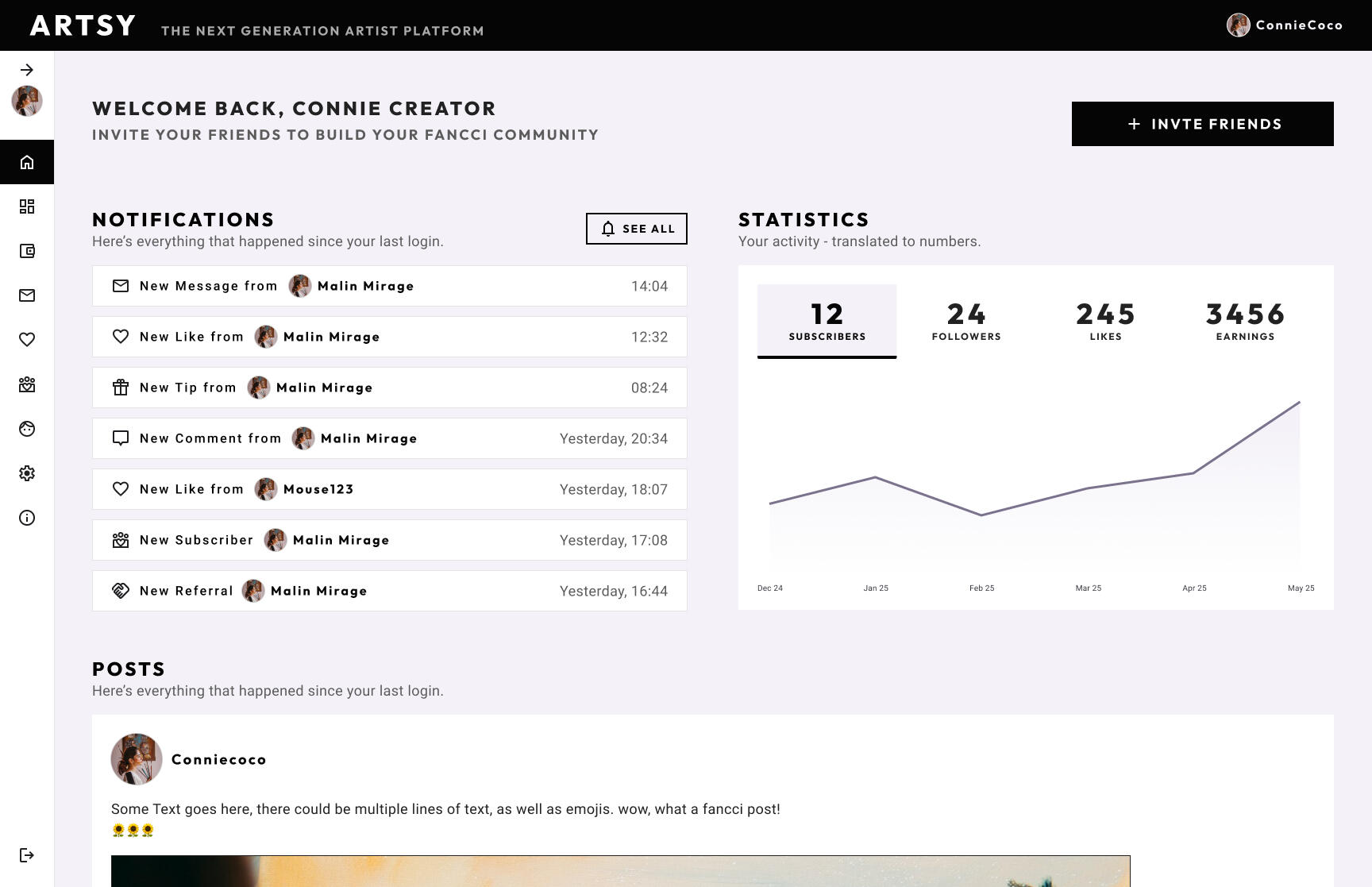
Dashboard

Creator Catalog

Filter Concept

Creator Profile

Gallery

Image in gallery


Lessons Learned.
This project marked a pivotal moment in my growth as a designer.It challenged me to look past rigid, industry-specific requirement lists and focus instead on universal interaction patterns. By stripping away superficial business traits, I learned that completely different user groups often share identical functional needs, allowing me to see the hidden potential in salvaged work.Additionally, this experience reshaped my philosophy on ethical product strategy. I grew to understand that sustainable monetization is not about maximizing short-sighted financial friction, but about building clean, value-driven systems that protect user trust and ensure long-term profitability.
Interested?
Let's talk.
Impressum
Quinn Alex Dier
Dorotheenstr. 31
40235 DüsseldorfTel: +491709065893
E-Mail: [email protected]